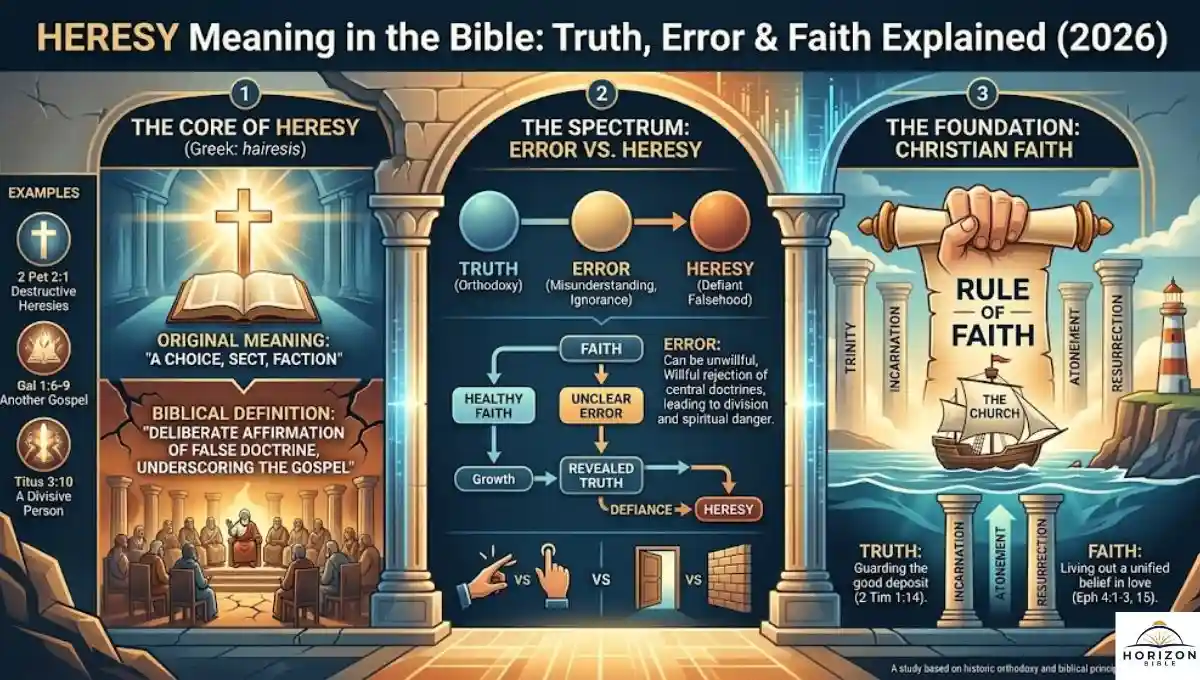
The word heresy sounds heavy and in Scripture, it truly is. Most believers have never been given a clear explanation of what it actually means. Understanding the heresy meaning in the Bible is not just an academic exercise. It is a matter of protecting your faith, staying anchored in God’s Word, and walking in truth when false teachings surround every church and platform. The Bible does not take false doctrine lightly. It is treated as dangerous, divisive, and destructive.
This article breaks down the heresy meaning completely from its original Greek roots to historical examples, modern warnings, and practical faith lessons. Studying the heresy meaning is one of the most important things a believer can do to protect their walk with God.
Heresy Meaning Bible
Meaning of Heresies in the Bible
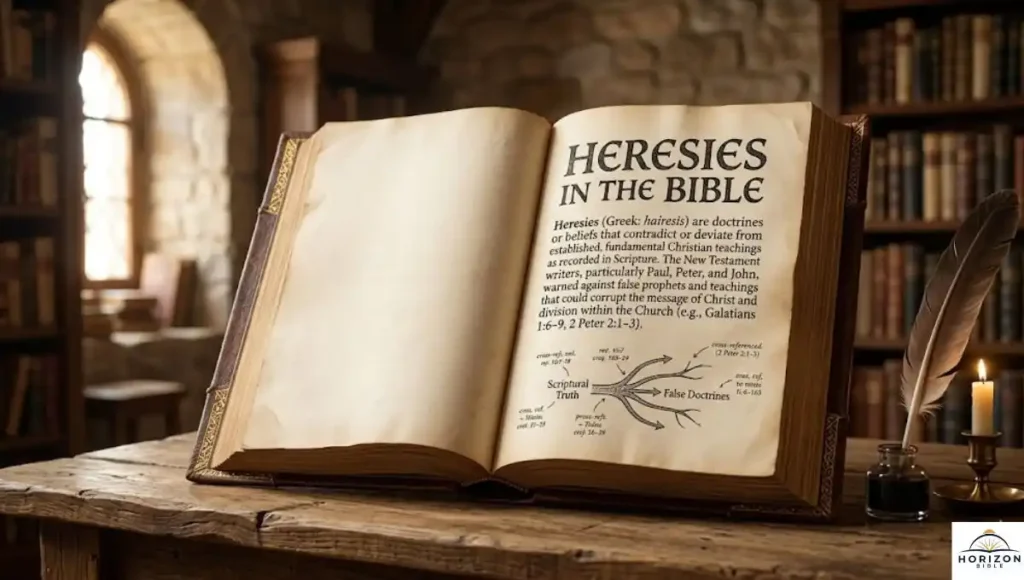
The heresy meaning in Scripture originates from the Greek word hairesis (αἵρεσις), which originally meant “a choice” or “a sect.” Over time, it came to describe any self-chosen opinion that divides the church or contradicts God’s revealed truth. Simply put heresy is choosing your own doctrine over God’s Word.
What Is Heresies in the Bible
In the New Testament, heresies describe destructive teachings that undermine essential Christian doctrine and fracture the unity of the body of Christ. The Apostle Peter warns directly in 2 Peter 2:1: “False teachers among you will secretly bring in destructive heresies, even denying the Master who bought them.”
Heretical Meaning in the Bible
A heretical teaching explicitly contradicts core gospel truth. Such as the divinity of Christ, salvation by grace alone, or the authority of Scripture. The heresy meaning here is unmistakable: it is not a minor disagreement but a rejection of what makes Christianity what it is. Anyone serious about protecting their faith must grasp this heresy meaning deeply.
Heresies Bible Meaning
Paul lists heresies among the works of the flesh in Galatians 5:19–20 (KJV), ranking it alongside strife and idolatry. This shows how seriously God views false doctrine and division inside the church.
Definition of Heresies in the Bible
| Term | Greek Origin | Biblical Meaning |
| Heresy | hairesis | A self-chosen opinion departing from God’s truth |
| Heretic | hairetikos | One who causes division through false doctrine |
| False teacher | NT usage | One who secretly introduces destructive teachings |
| Sound doctrine | NT usage | Teaching fully aligned with Scripture and the gospel |
Define Heresies in the Bible
What Does the Bible Say About Heresy
The heresy meaning is addressed with urgency across multiple New Testament books:
- 2 Peter 2:1 — False teachers secretly introduce destructive heresies
- Galatians 5:20 (KJV) — Heresies listed as a work of the flesh
- 1 Corinthians 11:19 — Heresies reveal who is genuinely approved by God
- Titus 3:10 — A heretical person must be warned twice, then avoided
- 1 John 4:1 — Test every spirit, because many false prophets are in the world
- Jude 1:3 — Believers are commanded to contend earnestly for the faith
What Is Heresy in the Bible
Heresy in the Bible is any teaching a person chooses over the revealed truth of God. Especially when it denies the nature of Christ, the gospel of salvation, or the authority of Scripture. The heresy meaning always carries two consequences: spiritual deception and church division. Every believer must treat the heresy meaning as a daily warning, not a distant theological concept.
What Is a Heresy in the Bible
A single heresy is a specific false doctrine that crosses from disagreement into denial. Denying Christ’s resurrection, teaching salvation by human effort alone, or claiming Jesus was not fully God. These are not gray areas. They are clear examples of what the heresy meaning warns against. The heresy meaning draws a firm line: truth is not negotiable.
Heresy Meaning in Bible
Heresy Definition Bible
The heresy meaning in biblical terms has three layers:
- Choice — A deliberate decision to follow doctrine outside of Scripture
- Division — The result of that choice breaking the unity of the church
- Destruction — The spiritual damage caused when believers are led astray
Heresies Definition Bible KJV
In the King James Version, “heresies” appears four times. Each use reflects either party-spirit divisions (1 Corinthians 11:19), works of the flesh (Galatians 5:20), or destructive false teaching (2 Peter 2:1). The heresy meaning in the KJV emphasizes both the act of choosing and the spiritual harm that follows.
Punishment for Heresy in the Bible
The Bible does not prescribe physical punishment for heresy but it outlines clear spiritual and communal consequences:
- Titus 3:10 — Warn a divisive person twice, then have nothing to do with them
- 2 John 1:10 — Do not welcome false teachers or endorse their doctrine
- 2 Peter 2:1 — Destructive heresies bring swift destruction on those who introduce them
- Historically, the Council of Nicaea (325 AD) formally condemned Arianism, which denied Christ’s full divinity
Example of Heresy in Christianity
Heresy Examples
Some of the most significant heresies in church history condemned by church councils and creeds include:
| Heresy | Core Error | Church Response |
| Arianism | Jesus was created, not eternal God | Condemned at Council of Nicaea, 325 AD |
| Gnosticism | Secret knowledge, not faith, brings salvation | Refuted by early church fathers |
| Pelagianism | Humans earn salvation without God’s grace | Condemned at Council of Ephesus, 431 AD |
| Nestorianism | Christ had two separate persons, not one | Rejected at Council of Ephesus |
| Modalism | Father, Son, and Spirit are not distinct persons | Declared heretical by early church |
Heresies in the Church Today
Modern heresies often arrive dressed in spiritual language. Common examples include:
- Prosperity gospel — Teaching that faith guarantees health and wealth
- Distorted grace — Claiming grace permits ongoing, unrepentant sin
- Denial of biblical authority — Treating Scripture as culturally outdated
- Works-based salvation — Teaching that human effort earns right standing with God
Recognizing the heresy meaning in modern teachings requires spiritual discernment and faithfulness to Scripture. The believer’s strongest defenses against these errors.
Biblical Meaning of Heresy
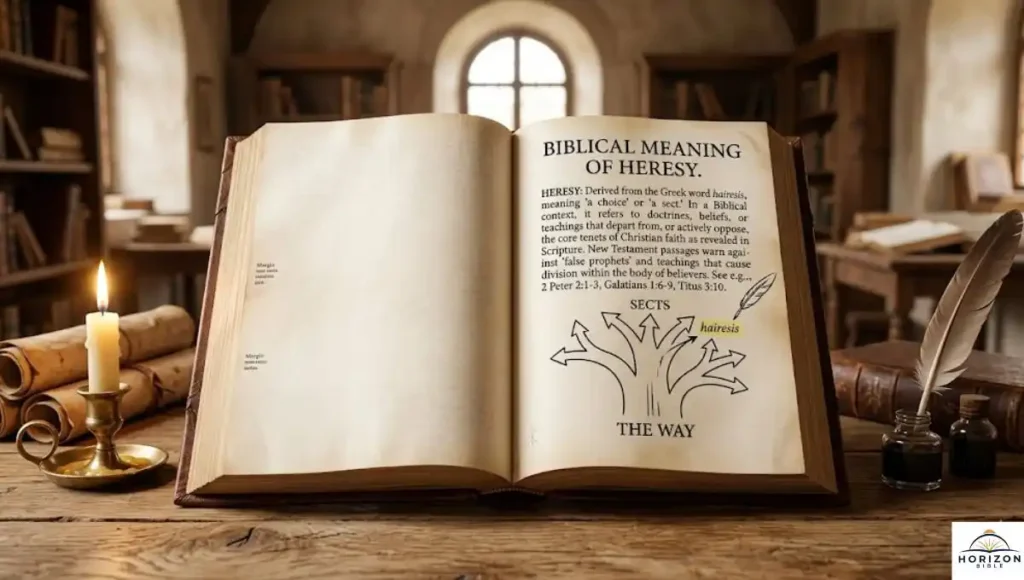
The heresy meaning at its deepest biblical level is a rejection of God’s authority in favor of human reasoning. It is the opposite of sound doctrine. Heresy thrives where believers neglect Scripture, where teachers go unchallenged, and where unity is valued above truth. Every time you encounter the heresy meaning in God’s Word, it is an invitation to examine your doctrine, test your teachers, and return to the simplicity of the gospel.
Spiritual Significance and Symbolism
Spiritually, the heresy meaning represents the timeless battle between truth and deception. The same battle that began in Genesis when the serpent asked, “Did God really say?” Every believer who understands the heresy meaning is better equipped to guard their heart. Key spiritual lessons include:
- Heresy grows where biblical wisdom is neglected
- Spiritual vigilance is a biblical command, not an optional practice
- Walking in truth requires daily engagement with God’s Word
- Holy Spirit discernment is the believer’s most vital tool against false teaching
- Spiritual maturity means recognizing error without compromising love
Read More : Theo Meaning in Bible: A Powerful Name Rooted in God’s Presence
Biblical Interpretations in Dreams or Real Life
Some believers experience moments of spiritual conviction or unease when exposed to false doctrine. A sermon that misquotes Scripture, a teaching that removes the cross, or a community that discourages questions about theology. These are real-life signals to seek God’s guidance, open the Bible, and test what is being taught.
The heresy meaning in everyday life is a call to spiritual alertness. When something feels spiritually wrong, do not dismiss it, bring it to Scripture, test it, and pray over it.
Practical Lessons & Faith Insights
Grasping the heresy meaning fully produces five practical outcomes for every believer. Apply each one and the heresy meaning becomes not just knowledge but a shield:
- Read Scripture daily—You cannot recognize error without knowing the truth
- Test every teaching—Use 1 John 4:1 and 2 Timothy 3:16 as your standard
- Stay in community—Heresies flourish in isolation; sound doctrine is protected in faithful fellowship
- Speak the truth in love—Protecting others from false teaching is an act of grace
- Remain humble—Even sincere believers can drift; obedience to God keeps us anchored
FAQs
Q: What is the heresy meaning in the Bible?
Heresy refers to a self-chosen doctrine that contradicts essential Christian truth and creates division in the church.
Q: Where does the word heresy come from?
It comes from the Greek word hairesis, meaning “a choice” or “a sect.”
Q: Is heresy a sin according to the Bible?
Yes, Galatians 5:20 lists heresies among the works of the flesh, alongside strife and idolatry.
Q: What is the difference between heresy and blasphemy?
Heresy is false doctrine within the church; blasphemy is a direct offense against God’s honor, often external.
Q: What are examples of heresy in Christianity?
Arianism, Gnosticism, and Pelagianism are the most historically significant and biblically documented examples.
Q: How did the early church handle heresy?
Through Scripture-based refutation, church councils like Nicaea, and creeds such as the Nicene Creed.
Q: How can Christians recognize heresy today?
By staying anchored in God’s Word, applying Holy Spirit discernment, and testing every teaching against Scripture.
Conclusion
The heresy meaning in the Bible is a serious call to every believer: guard your faith, know the truth, and refuse to be misled by teachings that sound spiritual but deny the gospel. From the Greek word hairesis to the warnings of Peter, Paul, and John, Scripture equips believers to identify error, stand firm in sound doctrine, and protect the unity of the church. Spiritual discernment is not a gift for a few. It is a responsibility for all who follow Christ.
Do not wait for false doctrine to shake your foundation. Be proactive in walking in truth anchored in Scripture, led by the Holy Spirit, and committed to the unchanging gospel of Jesus Christ. As Jude 1:3 urges: contend earnestly for the faith, because truth is always worth protecting and the church is always worth guarding.

Abdul Mannan Haider | Founder of HorizonBible.com Christian author and scripture researcher with 7+ years of experience. Providing faith-filled prayers, biblical blessings, and deep word studies to help global believers connect with the truth of the Bible.